
SaaS is the operating system of modern business.
Which is exactly why it becomes dangerous when nobody owns it.
Not “dangerous” like a theoretical risk. Dangerous like:
- a renewal you meant to cancel that auto-renews for a year at full price,
- a sales org locked out of Salesforce because the payment card expired,
- an audit where you can’t prove who approved what or who still has access,
- finance losing hours every week chasing invoices just to close the month,
- and six zombie accounts you’ve been paying for since people left years ago.
These aren’t edge cases — they’re the predictable outcomes of managing a growing SaaS stack with spreadsheets, inbox searching, and tribal knowledge.
As one operator put it:
“The process is getting out of control. We have so many subscriptions now that it’s impossible to keep track in Excel.”
This post is the “authoritative” version of SaaS management:
- what it actually is,
- why teams adopt it (the real triggers),
- the pain/emotions/disasters that show up when you don’t have it,
- and exactly when + how to implement it without turning your company into procurement bureaucracy.
What is SaaS management?
SaaS management is the business practice of discovering, tracking, and optimising a company’s software subscriptions to reduce spend and compliance risks across their lifecycle:
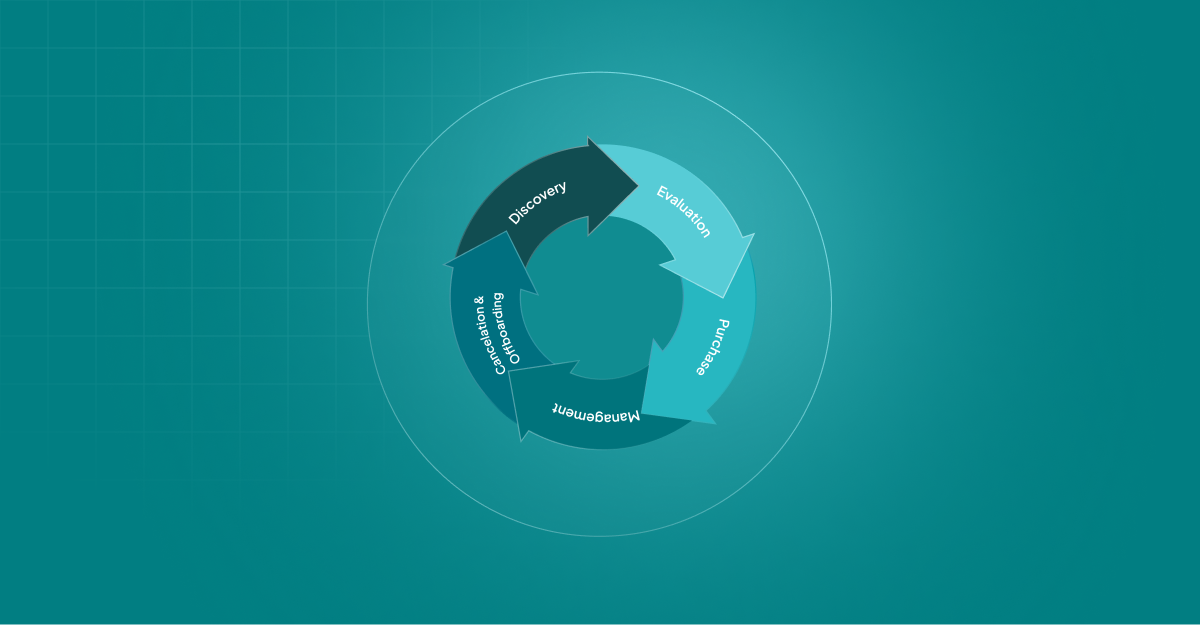
Request → Approval → Purchase → Provisioning → Renewal/Optimisation → Offboarding
A mature SaaS management program answers, in real time:
- Inventory: What SaaS apps do we have? Who owns each? Who uses it?
- Spend: How much are we spending per tool/team/entity? What’s changing month to month?
- Renewals: What renews when, on what terms, with what notice periods — and who decides?
- Licenses & access: Who has access? Who should? Who left but still has seats?
- Invoices & reconciliation: Where are invoices, contracts, receipts — and can finance close without chasing people?
- Governance: What’s the approval workflow and audit trail for new tools, upgrades, and access?
Most companies think they have this covered — until a board question, an audit, a failed payment, or a surprise renewal proves they don’t.
Why SaaS management matters more now
1) App sprawl is the new normal
Okta’s 2025 Businesses at Work report notes the global average number of apps per customer has topped 100 — and growing app footprints expand attack surface and management complexity.
If you’re a scaling company, the practical implication is simple: your “SaaS perimeter” is far larger than your org chart suggests.
2) The “buyer” of software is now the business — not just IT
IBM (citing Gartner) reports that 38% of technology purchases are managed, defined, and controlled by business leaders rather than IT — a structural reason shadow IT exists even in well-run companies.
3) Shadow IT (and shadow AI) is accelerating
A 1Password report (2025) found 52% of employees have downloaded apps without IT approval, and highlighted growing “shadow AI” usage (unsanctioned tools and policy non-compliance).
This is why SaaS management is no longer “nice to have.” It’s a core operating capability: visibility, control, and accountability — across spend and access.
The real triggers that force companies to adopt SaaS management
Nobody wakes up and says, “Today I want a governance framework.”
They adopt SaaS management when the current state starts to hurt — financially, operationally, emotionally.
Below are the most common “why now” triggers, pulled from real customer/prospect calls.
Trigger 1: Scale breaks spreadsheets
As companies expand, manual tracking methods like Excel move from being a helpful utility to a liability. The sheer volume of transactions eventually outpaces human ability to manually reconcile them without errors.
“The process is getting out of control… impossible to keep track in Excel.”
“The current process is manageable with 10–15 subscriptions, but as we grow, this won’t scale.”
Trigger 2: Surprise renewals create instant urgency
Subscription contracts often contain auto-renewal clauses that lock businesses in for another year if a cancellation window is missed by even a single day. Without a centralised calendar, these critical dates are easily buried in email threads, leading to unavoidable and unwanted spend.
“Recently, one of our performance management tools renewed automatically and cost us £20,000 because we forgot to cancel in time. We need reminders!”
“We failed to cancel a contract within its 60-day notice period… got auto-renewed for a year at full price.”
Trigger 3: Finance can’t get predictable cash flow visibility
You cannot forecast cash flow accurately when subscription costs are hidden in scattered expense reports and personal reimbursements. Finance leaders need real-time visibility into burn rates to manage budgets effectively and avoid month-end surprises.
“We don't get any regular oversight into what is expected on what day… We want better cash flow visibility.”
“Right now, if someone asked me ‘how many SaaS tools do we have?’ I don't have an answer.”
Trigger 4: Waste and duplication become visible (often via an audit)
Decentralised purchasing often leads to multiple teams buying the same tool or paying for license tiers they don't actually use. Identifying and cutting this "dead weight" is the fastest way to lower operational costs without impacting productivity.
“Leadership asked for a SaaS audit and we were shocked at the duplications. We need one place to see it all going forward.”
“We recently paid for 40 licenses but only used 20—no way to check this before.”
“We paid for the same thing three times and nobody knew.”
Trigger 5: Offboarding becomes a cost + security risk
When employees leave, they shouldn't take company data or active licenses with them. Manual offboarding processes create significant security risks (Shadow IT) and financial leakage when access isn't revoked immediately upon departure.
“The onboarding and offboarding process is cumbersome, and we sometimes keep paying for tools that people aren't using anymore because we lose track.”
“We discovered that we were paying for six different Zoom or Slack accounts that belonged to people who left the business years ago.”
Trigger 6: Audit/compliance demands proof — not promises
Modern security frameworks like SOC2 and ISO27001 demand proof of governance, not just policy documents. Auditors require concrete, traceable evidence of who granted access to a tool, when it was approved, and when that access was revoked.
“We’re coming up for a SOC2 audit—we need proper audit trails for approvals and access.”
“During the last audit, we couldn't prove who had access to which SaaS tools… We need a traceable process for compliance going forward.”
“We have no audit trail for who approved what. We can’t show regulators that we even have controls in place.”
Trigger 7: Payments chaos causes downtime (and panic)
Relying on a single physical corporate card for critical infrastructure is a massive operational risk. If that card is lost, compromised, or expires, it can trigger a domino effect of service outages across your entire software stack.
“We lost access to Salesforce because the payment card expired… our entire sales team was blocked for a day.”
“One of our company cards got replaced… some of them failed, and we lost access or got charged late fees.”
“No one realised our main payment card expired; suddenly, AWS services were shut off… It was a disaster.”
Trigger 8: M&A / new entities blow up visibility overnight
Mergers, acquisitions, or the creation of new international entities often fragment spend data. Without a unified system, finance teams lose the ability to see consolidated spend across the entire organisation.
“We merged with another company and now have no idea what we’re spending across entities. We need to consolidate our view.”
Trigger 9: The expense tool isn’t built for subscriptions
General expense platforms are excellent for employee reimbursements but often lack the lifecycle management features needed for software, such as renewal alerts and usage tracking.
“We use Pleo for expenses, but there’s no proper subscription module. We want a system built for managing software, not just cards.”
The true cost of unmanaged SaaS: pain, emotion, and disasters
Unmanaged SaaS rarely fails in one big cinematic explosion.
It fails in small, frequent cuts — until one day you hit a real incident (downtime, audit finding, or a giant renewal) and realise you’ve been running your company on luck.
Disaster 1: Renewals you didn’t choose
Unplanned auto-renewals are the most direct form of financial leakage in SaaS. When you lack a centralised renewal calendar, strict notice periods slip by unnoticed, locking you into costly contracts you intended to cancel.
“Recently… renewed automatically and cost us £20,000 because we forgot to cancel in time.”
“We have wasted thousands of pounds on lapsed licenses due to a lack of processes.”
“We failed to cancel… within its 60-day notice period… auto-renewed for a year at full price.”
Emotion: blindsided, annoyed, embarrassed (“How did we miss this?”).
Root cause: no renewal calendar, unclear owners, no notice-period tracking, no workflow.
Disaster 2: Zombie spend and silent duplication
Without usage monitoring, companies inevitably pay for "shelfware"—licenses that were purchased but are never actually used. This often manifests as paying for duplicate tools across different teams or retaining active seats for employees who no longer need them.
“We recently paid for 40 licenses but only used 20…”
“We paid for the same thing three times and nobody knew.”
“Six different Zoom or Slack accounts… people who left years ago.”
Emotion: disbelief, frustration (“We’re paying for what?”).
Root cause: fragmented purchasing, weak offboarding, no system of record.
Disaster 3: Downtime from payment failure (the scariest kind of preventable)
Relying on a shared corporate credit card creates a single point of failure for your entire tech stack. If that card expires, is lost, or hits a spending limit, critical infrastructure can go offline instantly, halting operations until a new payment method is added.
“We lost access to Salesforce… entire sales team was blocked for a day.”
“AWS services were shut off… It was a disaster.”
Emotion: panic, firefighting, leadership escalation.
Root cause: shared cards across many vendors + no ownership model + no monitoring.
Disaster 4: Audit findings and governance gaps
Compliance audits require you to prove that unauthorised users do not have access to sensitive data. Manual spreadsheets fail here because they lack immutable timestamps and approval logs, often leading to negative findings during due diligence.
“During the last audit, we couldn't prove who had access…”
“We have no audit trail for who approved what.”
“It saves us from the headaches of policy breaches and last-minute panic at audit time.”
Emotion: anxiety, loss of confidence, fear of exposure.
Root cause: approvals in Slack/email, access decisions undocumented, evidence scattered.
Disaster 5: Month-end close becomes a recurring tax on your best people
The hidden cost of unmanaged SaaS is the administrative burden placed on high-value finance talent. Instead of strategic forecasting, finance teams lose countless hours manually chasing receipts and reconciling bank transactions every month.
“It takes me 4 hours every week just to chase people for invoices and upload them to our accounting software.”
“It feels like having an additional team member… I’m saving about four hours a week on invoice-related tasks.”
Emotion: resentment, burnout, constant low-grade stress.
Root cause: invoices in inboxes, no automated capture, no reconciliation workflow.
When should you implement SaaS management?
The practical answer:
Implement SaaS management when the cost of “keeping it in your head” exceeds the cost of running a real system.
Here are the most reliable early signals (the ones that show up in real companies before the big incident happens).
You should implement SaaS management now if…
1) You’re past ~10–15 subscriptions (and growing)
There is a specific tipping point where the administrative overhead of manual tracking begins to outweigh the utility of the software itself. Once you exceed this threshold, spreadsheets inevitably fail to keep pace with the rate of new adoption.
“Manageable with 10–15 subscriptions, but as we grow, this won’t scale.”
2) Renewals surprise you more than once a quarter
If renewals are a scramble (or a Slack fire drill), you don’t have renewal management — you have renewal anxiety. When you rely on vendor emails rather than a centralised calendar, you are constantly reacting to charges instead of planning for them. This lack of oversight inevitably leads to unwanted auto-renewals and panic decisions.
3) You can’t confidently answer basic questions
If you cannot instantly pull a report on your software inventory, you are operating with a blind spot in your operational budget. This visibility gap makes it impossible to accurately forecast spend or identify where money is being wasted.
“If someone asked me ‘how many SaaS tools do we have?’ I don’t have an answer.”
4) Offboarding is leaky
Manual offboarding processes often leave "ghost" accounts active long after an employee has departed. This disconnect between HR and IT creates both unnecessary costs and significant security vulnerabilities.
“We sometimes keep paying for tools that people aren't using anymore because we lose track.”
5) You’re heading into SOC2 / ISO27001 (or enterprise customer scrutiny)
Auditors require more than just a policy; they demand proof that you control access to every tool in your stack. Trying to reconstruct these audit trails manually is a high-risk strategy that often leads to negative findings.
“We’re coming up for a SOC2 audit—we need proper audit trails…”
6) You’ve had one payment-related incident (or you fear one)
If your entire tech stack depends on a single card, you are one fraud alert or expiration date away from operational paralysis. Diversifying payment methods is critical to ensuring business continuity and avoiding service outages.
“We lost access to Salesforce because the payment card expired…”
7) Your finance team is spending hours chasing invoices
Finance teams should be focused on strategy, not low-value administrative work like hunting down receipts. If your month-end close is delayed by missing paperwork, your process is fundamentally broken.
“4 hours every week just to chase people for invoices…”
A simple SaaS management maturity model
This is useful for aligning execs fast.
Level 0 — Reactive chaos
- Purchases happen anywhere
- Renewals are surprises
- Offboarding is inconsistent
- Symptoms: “We paid for the same thing three times.”
Level 1 — Inventory
- You can list tools, owners, renewals (even if imperfect)
- Finance can see recurring spend
- Symptoms improving: fewer “what is this charge?” moments.
Level 2 — Workflow
- New tool requests and upgrades follow a process
- Renewals have owners and timelines
- Invoices go to one place automatically
- Result: fewer fire drills, better forecasting.
Level 3 — Governance
- Audit trails exist for approvals and access
- Offboarding is tied to access + licenses
- Policies are enforced (not optional)
- Result: calm audits and fewer risks.
Level 4 — Optimisation
- Usage and licensing are continuously optimised
- Redundancy is reduced over time
- Negotiations are proactive (not reactive)
- Result: compounding savings and stronger controls.
What “good” SaaS management actually looks like (capabilities that change outcomes)
1) A single source of truth (real visibility)
"Good" management replaces fragmented spreadsheets with a consolidated dashboard that acts as the definitive record for all software assets. This centralisation ensures that every stakeholder, from finance to IT, operates from the same accurate data set regarding usage and spend.
“We need one place to see it all going forward.”
“Everyone can see here… know what tools they're using and should use.”
2) Renewal management that prevents “£20,000 moments”
Proactive renewal management moves you from a reactive stance to a strategic one by alerting you well in advance of contract expirations. This capability ensures you have the necessary runway to negotiate better terms or cancel unwanted services before you are locked in.
“We need reminders!”
“Reminders… are so important, as I often get blindsided by them.”
3) Automated invoice capture + accounting integration
By automating the collection and reconciliation of invoices, you eliminate the manual friction that typically slows down month-end closes. This integration ensures that every transaction is instantly matched to its corresponding documentation without human intervention.
“The automated invoice capture feature… streamlines the invoicing process significantly.”
“The Xero integration is straightforward and very time-saving…”
4) Waste reduction (licenses + duplicates)
Effective SaaS management provides the granular visibility needed to identify and eliminate overlapping tools and unused seats. This continuous optimisation process ensures that capital is only deployed towards software that drives actual business value.
“We recently paid for 40 licenses but only used 20…”
“We’ve already canceled a couple of duplicate tools we never noticed before.”
5) Offboarding that stops zombie spend and reduces security risk
A robust offboarding process connects personnel changes directly to software access, ensuring immediate revocation of licenses when employees leave. This prevents the accumulation of "zombie" spend and closes critical security gaps caused by lingering access
“We sometimes keep paying for tools… because we lose track.”
6) Audit trails + approvals (governance without slowing teams down)
Modern governance embeds approval workflows directly into the purchasing process, creating an immutable record of decisions without creating bottlenecks. This "verify-then-trust" approach satisfies compliance requirements while keeping teams agile.
“We need proper audit trails for approvals and access.”
“It saves us from… last-minute panic at audit time.”
7) Payment resilience (one tool, one payment method, reassignable ownership)
Decoupling payments from a single corporate card by assigning unique virtual cards to each subscription isolates risk and simplifies ownership. This structure ensures that a single compromised card or staffing change does not disrupt the entire technology stack.
“Every tool has its own card and I can just reassign it.”
SaaS management vs expense management vs procurement
This is where many companies waste 6–12 months.
- Expense management is optimised for reimbursements, employee spend, and receipts.
- Procurement is optimised for sourcing, vendor onboarding, and purchase approvals.
- SaaS management is optimised for the subscription lifecycle: renewals, licenses, access, invoices, governance.
Operators say it plainly:
“We use Pleo for expenses, but there’s no proper subscription module.”
If your pain is renewals, access, licensing waste, audit trails, and ongoing subscription operations — you need SaaS management.
How to implement SaaS management (30 / 60 / 90 day plan)
If you want this to stick, do not start with policy documents.
Start by building the system of record, then operationalise the workflows that prevent the biggest disasters.
Days 1–30: Build your system of record (inventory + owners)
Goal: Answer “what do we have?” with confidence.
- Pull recurring spend signals (card statements, AP, existing contracts)
- Build inventory: tool, cost, renewal date, notice period, owner, team, payment method
- Assign owners for top 20 tools (not “admin user” — a real accountable owner)
Why it matters:
“Right now… I don’t have an answer.”
Days 31–60: Stop predictable disasters (renewals + invoices)
Goal: remove fire drills.
- Renewal workflow: reminders + decision owners + notice-period tracking
- Central invoice intake and automated capture where possible
- Accounting integration for reconciliation and close
Why it matters:
“4 hours every week… chase people for invoices…”
Days 61–90: Scale governance (approvals + onboarding/offboarding)
Goal: make good behavior the default.
- Approval flows for new tools and upgrades
- Offboarding workflow tied to access + licenses
- Evidence capture for audits (who approved what, when, and why)
Why it matters:
“We need proper audit trails for approvals and access.”
The SaaS management business case (how to justify it internally)
You can build a strong business case on four levers:
- Hard savings: eliminate duplicates, reclaim unused licenses, avoid unwanted renewals
- Time savings: reduce invoice chasing, reconciliation, and manual audits
- Risk reduction: prevent downtime, reduce audit findings, reduce shadow IT exposure
- Decision quality: budgeting, forecasting, accountability
A simple ROI framing that resonates with CFOs:
- Recovered waste (even modest) + avoided renewal mistakes + hours saved → pays for the program quickly.
Gartner has also noted organisations can reduce software expenses materially with optimisation practices (historically citing up to ~30% in mature license optimization contexts).
Conclusion: Don’t wait for the £20,000 mistake
The transition from spreadsheets to SaaS Management is a defining moment in a company’s operational maturity. As the customer stories above prove, the "do nothing" cost is not zero—it is measured in wasted capital, hours of administrative drudgery, and the constant risk of a compliance failure.
Ultimately, SaaS management solves the "chaos and inefficiency" caused by manual tracking. It moves your finance and IT teams from reactive firefighting to proactive strategy.
The difference between a frantic month-end close and "peace of mind" is simply having the right system in place. You can continue to rely on luck, hoping a critical card doesn't expire and a renewal isn't missed—or you can take control.
Ready to stop the sprawl?If you recognized your own organistion in the "Triggers" list above, you are already paying for SaaS management through waste and inefficiency—you just aren't getting the benefits yet.